A.S.98 Size Guide — AS98 Sizing Chart & Fit | Boots by TL
Sizing Guide · 2026-04-11
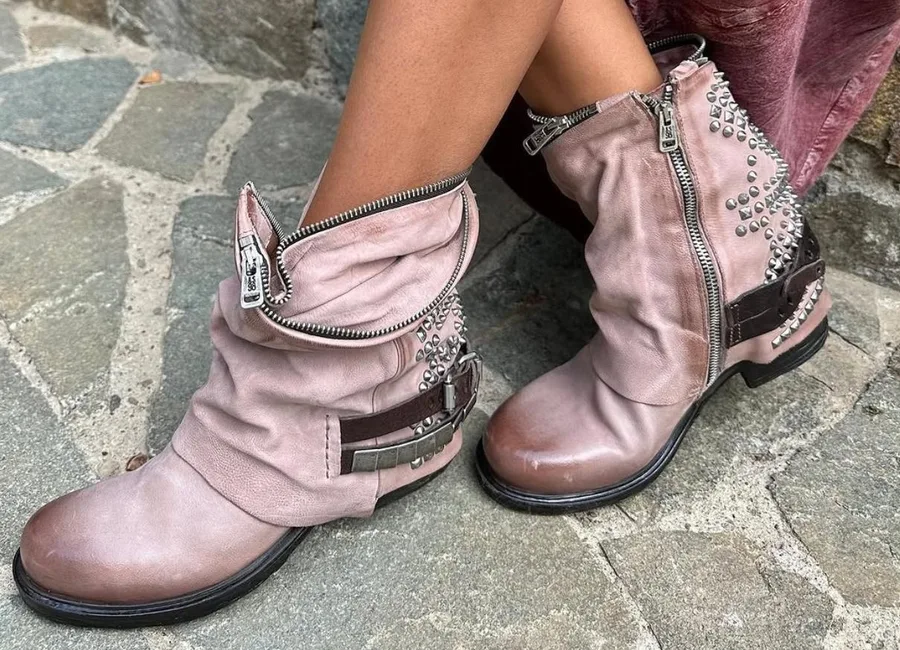
If you are shopping A.S.98 for the first time — often written AS98 or A.S. 98 — sizing is the first question. Most guides answer it with a conversion chart: EU 38 is a US 8, and good luck. That works until it doesn't, because a label is a label. A.S.98 builds on many different lasts, and a sculpted sandal and a chunky biker boot in the same EU size do not measure the same inside.
There is a better way, and it takes two minutes: measure your foot, then match it to the foot length each size is actually built for. That is a real number about your real foot, not a conversion between two labels. Everything below is built around it.
The one rule that decides your size
> Your foot must be SHORTER than the inside of the shoe. > > - Boots — your foot should measure 1–1.5 cm (0.4–0.6 in) shorter than the boot's inside length. > - Sandals — 0.5–1 cm (0.2–0.4 in) shorter is enough. > > A shoe whose inside length equals your foot length is too small. Your toes will touch the front, and leather does not gain length.
This is the part most people get backwards. They measure a 24.5 cm foot, see a 24.5 cm boot, and think perfect. It is not perfect — it is a size too small. Your foot needs somewhere to go when it flexes forward with every step, and a sock, an insole, or a warm afternoon all eat into that space.
Step 1 — Measure your foot
- Put a sheet of paper against a wall and stand on it, heel touching the wall, weight on the foot.
- Mark the tip of your longest toe. (It is not always the big toe.)
- Measure from the wall edge to the mark — that is your foot length.
- Measure both feet and use the longer one. Most people have a mismatch of a few millimetres.
- Measure in the evening, when feet are at their largest.
Step 2 — Find your size
Drag the slider to the number you just measured and it will tell you your size — or read it off the chart below.
[[as98-fit-finder]]
A.S.98 fits true to size. This is the foot length each size is actually built for:
| EU | US | UK | Your foot — best fit | Range that works |
|---|---|---|---|---|
| 35 | 5.5 | 2.5 | 21.3 cm / 8.4 in | 20.9–21.8 cm / 8.2–8.6 in |
| 36 | 6 | 3 | 22.2 cm / 8.7 in | 21.8–22.6 cm / 8.6–8.9 in |
| 37 | 7 | 4 | 23 cm / 9.1 in | 22.6–23.4 cm / 8.9–9.2 in |
| 38 | 8 | 5 | 23.8 cm / 9.4 in | 23.4–24.2 cm / 9.2–9.5 in |
| 39 | 9 | 6 | 24.6 cm / 9.7 in | 24.2–25 cm / 9.5–9.8 in |
| 40 | 9.5 | 7 | 25.4 cm / 10 in | 25–25.8 cm / 9.8–10.2 in |
| 41 | 10 | 8 | 26.2 cm / 10.3 in | 25.8–26.7 cm / 10.2–10.5 in |
| 42 | 11 | 9 | 27.1 cm / 10.7 in | 26.7–27.6 cm / 10.5–10.9 in |
How to read it: find your foot length in the last column and take that EU size. If you land near the top of a range and you wear thick socks or insoles, go up one.
Worked examples:
- Foot 22.2 cm (8.7 in) → EU 36
- Foot 23.8 cm (9.4 in) → EU 38
- Foot 25.4 cm (10 in) → EU 40
The sizes step about 0.8 cm apart, so a single size is a real difference — worth measuring properly rather than guessing.
This chart is women's sizing, EU 35–42. We have not published one for men's A.S.98, because the fit varies too much between models to chart honestly — a 43 can wear like a 44 on one pair and true to size on the next. Our men's listings carry fit notes for that specific pair instead, and you are always welcome to ask us — we will tell you what we know about the pair in front of you.
The footbed measurements we have taken
The chart above tells you your size. This one tells you the shoe — the actual heel-to-toe length of the footbed, measured by us on pairs that have come through our hands:
| EU | US | Footbed, heel-to-toe |
|---|---|---|
| 35 | 5.5 | ~23.1 cm / 9.1 in |
| 36 | 6 | ~24 cm / 9.4 in |
| 37 | 7 | ~24.5 cm / 9.6 in |
| 38 | 8 | ~25 cm / 9.8 in |
| 39 | 9 | ~25.5 cm / 10 in |
| 40 | 9.5 | ~26 cm / 10.2 in |
| 41 | 10 | ~26.8 cm / 10.6 in |
| 42 | 11 | ~27.7 cm / 10.9 in |
Most of these come from sandals, where the footbed is the platform your foot actually stands on and every millimetre of overhang shows — which is why we started measuring there first. EU 36 to 40 are averaged from pairs we have measured; 35, 41 and 42 follow the same progression and will be replaced as soon as we have measured pairs in those sizes.
This is not the same number as your foot length, and it is not meant to be. On a sandal, your foot sits on nearly the whole footbed — a 25.5 cm footbed suits a foot close to that length, with only a few millimetres to spare at the front. On a closed boot, you want roughly 1–1.5 cm more shoe than foot, because your foot slides forward as you walk.
Read this table as a guide, not gospel. A.S.98 builds on many different lasts, so two pairs in the same size can measure a few millimetres apart — we have recorded pairs as far apart as 25.5 cm and 27.3 cm in a single size. When a listing in our A.S.98 collection shows a measured heel-to-toe length, trust that number over this table — it is the actual shoe rather than an average of pairs like it. Every A.S.98 product page also has a built-in fit checker that compares your foot to that specific pair.
The official A.S.98 size conversion
This is A.S.98's own published conversion — useful for comparing against shoes you already own:
| EU | US | UK |
|---|---|---|
| 35 | 5.5 | 2.5 |
| 36 | 6 | 3 |
| 37 | 7 | 4 |
| 38 | 8 | 5 |
| 39 | 9 | 6 |
| 40 | 9.5 | 7 |
| 41 | 10 | 8 |
| 42 | 11 | 9 |
A.S.98 is an Italian brand, so EU is the real size and US/UK are the brand's own conversions. Use this to get in the right neighbourhood, then confirm with the measurement table above — the measurement is what decides the fit.
What this looks like in practice
Lia usually wears a 36 in A.S.98. Her foot measures 22.4 cm (8.8 in).
That is a 36 on the chart, and a 36 is what she wears — the table is not theory, it is the pairs that have come through our hands. A 35 is wearable on her but snug and narrow, so it only really works in flatter styles. A 37 gives her extra space, handy for thick socks or an insole, but comes up big.
Where it gets interesting is between two pairs that are both a 36. The chart tells you whether a size can fit; the last decides whether it fits well. One 36 measures 24 cm inside and another 24.4 cm, and the flatter, narrower one feels tighter despite being the same size. That is the gap a measured listing closes and a chart never can.
The important part: A.S.98 leather relaxes and molds, but it should not start painfully short. Snug is fine. Cramped is not.
If you are between two sizes
Ask one practical question: how do I actually want to wear this pair?
Go up when:
- you plan to wear thick socks, or wear the boots through winter
- you use orthotics or cushioned insoles
- you want a travel or all-day boot rather than a fitted fashion boot
- the toe is narrow or tapered
- you have had boots feel short on you before
Go down when:
- the style is clearly generous — some chunkier, wider models are
- it is a heel or a heeled sandal, where a closer fit stops your foot sliding forward
- you wear thin socks and will not add an insole
Going down is the rarer case, and it only works if the length is still correct. The mistake we see most often is choosing the tighter size because it looks more flattering standing still. Footwear has to work in motion.
Insoles are not a last resort
A slim leather or foam insole is often the smartest fix, especially on pre-owned pairs. It helps when the boot is right in length but a little roomy overall, when your heel lifts more than you would like, or when you want more cushioning on hard pavement.
The best fit is not always the size that looks mathematically perfect on the first try. Sometimes it is the size that gives you the best base and becomes ideal with an insole — which is another reason to leave room rather than take the tighter pair.
Break-in, or wrong size?
A.S.98 leather is usually soft from the start, so there is no dramatic break-in. What you feel on day one is close to how the boot will feel long term.
Give it time if: the leather feels slightly snug across the top of the foot, the shaft feels structured, or the sole feels firm before it flexes.
It is the wrong size if: your heel slips more than a few millimetres, or your toes touch the front even slightly. Neither of those fixes itself. The leather will soften and adapt across the width and instep — it will not gain length.
If you just want the answer
- Measure your foot, then use the table — this beats every conversion chart
- A.S.98 fits true to size — the chart above is the answer for most people
- Sizes step ~0.8 cm, so one size really is a different shoe
- Between sizes: go up for boots
- Thick socks or insoles: go up
- Toes touching the front: do not risk it, go up
- Heels and heeled sandals: going down can improve stability
- A listing shows a measured length? Trust it over any chart
Frequently asked questions about A.S.98 sizing
Does A.S.98 run small?
Usually no. Most styles read true to size once you convert from EU sizing properly. What feels like "running small" is nearly always a foot measured against the wrong number — a shoe needs to be longer than your foot, not equal to it.
What is the internal length of an A.S.98 in my size?
From the pairs we have measured: about 24 cm (9.4 in) at EU 36, 25 cm (9.8 in) at EU 38 and 26 cm (10.2 in) at EU 40 — see the full footbed table above. It varies more than the size chart does, because A.S.98 uses many lasts, so check the measured length on the listing when there is one.
How long should my foot be for a size 39?
About 24.6 cm (9.7 in), and anything from 24.2 to 25 cm (9.5–9.8 in) works. The footbeds we have measured in a 39 come in around 25.5 cm (10 in) — close fit on a sandal, comfortable room in a boot.
Do A.S.98 boots stretch?
They soften and mold with wear, especially across the width and instep. They do not stretch meaningfully in length.
How do I know a pre-owned A.S.98 pair will fit me?
Measure your foot and take the size from the chart above. If the listing also shows a measured heel-to-toe length, check that it is about 1–1.5 cm longer than your foot — that confirms the individual pair, not just the size. Every A.S.98 product page has a fit checker that does this for you.
The listing has no measurement — what then?
Use the table above and ask us. We can measure a specific pair before you buy — just send us the SKU.
Ready to find your pair? Browse our current A.S.98 boots and sandals — many pairs now include a measured heel-to-toe length, so you can size by the number instead of guessing.